Differences in Calcium Fertilizer Requirements Across Crops: Why Are Global Fruit and Vegetable Farms Increasing Their Use of Calcium Nitrate?
I. Why Has Calcium Fertilizer Become So Critical? (2025 Global Trends)
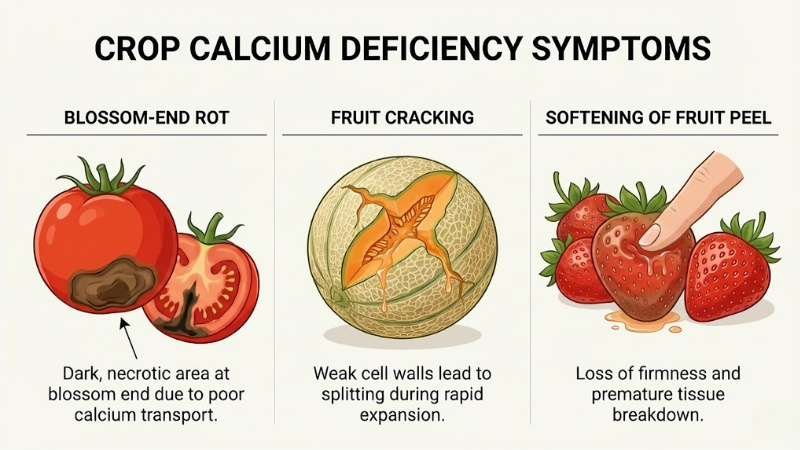
Calcium (Ca) is a vital structural component in plants, playing essential roles in cell wall formation, root development, fruit firmness, and stress resistance. However, unlike nitrogen, phosphorus, and potassium, calcium cannot move freely within the plant. This means:
Whenever crops experience rapid growth or increased environmental stress, calcium deficiency symptoms are likely to appear.
As we enter 2025, fruit and vegetable farms worldwide are significantly increasing their use of calcium fertilizers, primarily due to:
1. Rapid expansion of high-value crops (tomatoes, berries, grapes, chili peppers)
2. Widespread adoption of drip irrigation systems, making water-soluble calcium fertilizers the most effective delivery method
3. Increasing climate volatility → higher incidence of physiological disorders caused by calcium deficiency
4. Rising export market demands for fruits with improved firmness and storability during transport
Consequently, calcium nitrate has become one of the fastest-growing water-soluble fertilizers globally.
II. Types of Calcium Fertilizers: Why Is Calcium Nitrate Preferred Over Other Calcium Sources?
Common calcium fertilizer types and their characteristics:
| Calcium Source | Solubility | Calcium Content | Advantages | Disadvantages |
|---|---|---|---|---|
| Calcium Nitrate | Very High | Ca ≥ 26% | ✔ Rapid uptake ✔ Chloride-free ✔ Ideal for drip irrigation | Higher cost than lime-based calcium |
| Calcium Chloride (CaCl₂) | High | High | ✔ High calcium content ✔ Low cost | ✘ Contains chloride, which can cause leaf burn |
| Lime-based Calcium (CaO/CaCO₃) | Low | Moderate | ✔ Low cost | ✘ Slow dissolution; unsuitable for intensive agriculture |
| Chelated Calcium (EDTA-Ca) | Moderate | Moderate | ✔ Highest absorption efficiency | ✘ Extremely high cost |
🔍 Why calcium nitrate stands out:
- High solubility (suitable for both drip irrigation and foliar application)
- Rapid uptake (NO₃⁻ anions facilitate calcium mobility)
- Chloride-free (ideal for sensitive crops like grapes, berries, and tomatoes)
- Compatible with most water-soluble fertilizers
Therefore, calcium nitrate has become the preferred calcium source for high-value fruit and vegetable crops.
III. Crop-Specific Calcium Requirements (Focus: Tomato, Grape, Blueberry, Citrus, Chili Pepper, Banana)
Below is an analysis of calcium needs for the world’s most representative crops in 2025:
1. Tomato — One of the Most Calcium-Deficiency-Prone Crops
Typical Calcium Deficiency Symptoms:
- Blossom-end rot
- Thin fruit skin, prone to cracking
- Small or misshapen fruits
Cause:
Rapid growth → insufficient calcium transport to fruits → fruit-specific calcium deficiency
Recommended Calcium Fertilizer:
✔ Drip-applied calcium nitrate at 5–8 kg/ha per application ✔ Foliar Ca sprays (as supplement)
Tomato is one of the crops with the highest calcium demand.
2. Grape — Calcium Determines Berry Firmness and Transportability
Calcium Deficiency Symptoms:
- Reduced bloom (natural waxy coating)
- Thin skin, leading to higher transport damage rates
- Loose cluster structure
Recommended Calcium Sources:
✔ Calcium nitrate (Ca ≥ 26%)
✔ EDTA-Ca (for premium vineyards)
Grapes exhibit high economic sensitivity to calcium levels, with premium vineyards applying significantly more calcium.
3. Blueberry — Extremely Sensitive to Chloride
Blueberry is one of the most chloride-sensitive fruit crops, so only the following should be used:
✔ Chloride-free calcium sources: calcium nitrate
✘ Calcium chloride is prohibited
Recommended Application Method:
- Apply calcium via drip irrigation every 10–14 days
- Double the dosage during fruit expansion stage
The expanding global blueberry cultivation area is directly driving increased demand for calcium nitrate.
4. Citrus — Peel Thickness and Firmness Depend on Calcium
Calcium Deficiency Symptoms:
- Peel pitting
- Thin peel with poor storability and transportability
- Misshapen fruits that are juicy but prone to cracking
Recommended Calcium Sources:
✔ Calcium nitrate (for continuous supply)
✔ Calcium-magnesium compound fertilizers (CNM)
5. Chili Pepper — Highly Susceptible to Fruit Cracking and Calcium Imbalance
Chili pepper is a “calcium-sensitive crop.” Calcium deficiency leads to:
- Fruit cracking
- Wilting
- Flower drop
Recommended fertilization:
✔ Drip-applied calcium nitrate + foliar Ca sprays
✔ Combine with boron (to enhance calcium mobility)
6. Banana — Finger Firmness and Gloss Depend on Calcium Supply
Calcium influences:
- Finger firmness
- Shelf life
- Peel glossiness
- Bunch fullness
Recent growth in banana exports has driven annual calcium nitrate (CN) usage growth of 8–12%.
IV. Comparison of Calcium Application Methods: Drip Irrigation > Foliar Spray > Soil Drench
1. Drip Irrigation (Most Effective)
- Leverages the high solubility of calcium nitrate
- Provides consistent and stable calcium supply
- Suitable for all fruit and vegetable crops
2. Foliar Spray (Rapid Calcium Supplementation)
Ideal for:
- Tomatoes
- Chili peppers
- Late-stage grape production
3. Soil Drench
Suitable for:
- Acidic soils with severe calcium deficiency
V. 2025 Global Calcium Fertilizer Demand Forecast (Focus on Calcium Nitrate)
📈 Trend 1: Annual calcium nitrate demand growing at 8–12%
Driven primarily by Southeast Asia, South America, the Middle East, and Africa.
📈 Trend 2: Drip irrigation + premium horticulture becoming the main battleground
📈 Trend 3: Rapid rise in chloride-free calcium fertilizer market share
Export-grade fruits are highly sensitive to chloride.
📈 Trend 4: Surging demand for high-purity factory-grade calcium nitrate
Premium products with Ca ≥ 26% and Cl⁻ ≤ 0.02% are increasingly preferred.
VI. Why Are Farms Worldwide Increasing Calcium Nitrate Usage?
Overall, calcium contributes to plants in the following ways:
✔ Fruit firmness
✔ Extended shelf life
✔ Reduced fruit cracking
✔ Enhanced stress tolerance
✔ Improved quality and yield
✔ Lower post-harvest losses during storage and transport
As the calcium source with the fastest uptake, broadest compatibility, chloride-free composition, and drip-irrigation-friendly properties, calcium nitrate has become:
an essential nutrient standard in global fruit and vegetable production.
Hansol Chemical offers:
- High-purity calcium nitrate
- Calcium-magnesium compound fertilizers
- Crop-specific calcium nutrition solutions
- Drip-irrigation-optimized calcium fertilizers
- SGS-certified, consistently supplied, and export-compliant products suitable for diverse global agricultural markets.