Water-Soluble NPK Encyclopedia: Formulation Principles, Application Scenarios, Drip Irrigation Compatibility, and Crop Nutrition Programs (2025 Latest)
I. What Is Water-Soluble NPK?
Water-Soluble NPK Fertilizer is a professional-grade fertilizer fully soluble in water, designed specifically for use in drip and spray irrigation systems. It contains the three essential macronutrients critical for plant growth:
- Nitrogen (N): Promotes leaf and stem development
- Phosphorus (P): Enhances root development, rooting, flowering
- Potassium (K): Improves fruit quality and stress resistance
Compared to conventional compound fertilizers (e.g., granular NPK blends or extruded fertilizers), water-soluble NPK offers the following fundamental advantages:
✔ 100% water-soluble → No clogging of drip systems
✔ Precise nutrient control
✔ Rapid results
✔ Ideal for greenhouses, drip irrigation, tunnels, and orchards
✔ Formulations can be adjusted according to crop growth stages
As modern agriculture increasingly adopts precision management practices, water-soluble NPK has become the fastest-growing fertilizer category worldwide.
II. Three Core Advantages of Water-Soluble NPK
1. 100% Water-Soluble – Won’t Clog Irrigation Systems
Suitable for: Drip irrigation, sprinkler systems, micro-sprinklers, and film-based irrigation.
2. Fast Absorption and High Nutrient Use Efficiency
Offers 20–35% higher nutrient use efficiency compared to granular fertilizers.
3. Flexible Formulations – Customizable Based on Crop Needs
Examples:
- Rooting stage: High-phosphorus formulation
- Vegetative growth stage: Balanced formulation
- Fruit enlargement stage: High-potassium formulation
Ideal for all high-value crops (fruits, vegetables, grapes, berries, greenhouse vegetables, etc.).
III. Analysis of Mainstream Water-Soluble NPK Formulations (How to Choose the Right One?)
Below are six of the world’s most commonly used formulations and their recommended applications:
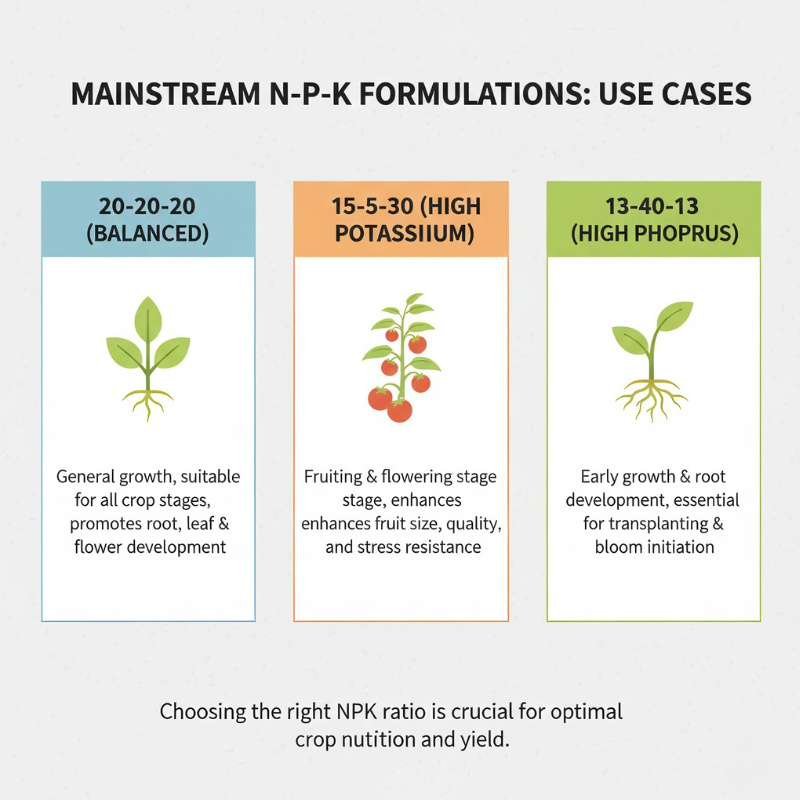
① 20-20-20 (Balanced)
Application Stage: Vegetative growth and vigorous growth phases
Crop Suitability: All fruits, vegetables, leafy greens, grapes, bananas, ornamentals
Benefits:
✔ Provides balanced, comprehensive nutrition
✔ Promotes synchronized growth of shoots, leaves, and roots
② 13-40-13 (High-Phosphorus)
Application Stage:
✔ Rooting phase
✔ Transplanting phase
✔ Flowering and fruit set promotion
Benefits:
✔ Strengthens root system development
✔ Stimulates flower bud formation
③ 15-5-30 (High-Potassium)
Application Stage: Fruit enlargement and quality enhancement phases
Crop Suitability: Tomatoes, grapes, berries, melons
Benefits:
✔ Increases sugar content and overall fruit quality
✔ Enhances fruit firmness
✔ Reduces fruit cracking
④ 12-3-43 (Ultra-High-Potassium)
Application: Premium export-grade fruits and vegetables requiring superior quality and firmness
Benefits:
✔ Significantly improves fruit color, firmness, and dry matter content
⑤ 30-10-10 (High-Nitrogen)
Application:
- Seedling stage
- Leafy vegetables
- Crops with high nitrogen demand for vigorous stem and leaf growth
⑥ NPK + Trace Elements (+TE)
Contains Fe, Mn, Zn, B, Cu, Mo
Suitable for regions with widespread micronutrient deficiencies (e.g., Southeast Asia, Middle East)
IV. Hansol Chemical’s Water-Soluble NPK Export Specifications
| Parameter | Description |
|---|---|
| Formulation Range | 10-52-10, 20-20-20, 15-5-30, 13-40-13, 12-3-43, Custom Formulations |
| Water Solubility | 100% water-soluble |
| Trace Elements | Available as chelated TE (EDTA) |
| Technical Features | Non-caking, rapid dissolution, no insoluble residues |
| Application Methods | Drip irrigation, foliar spray, fertigation, soil drench |
| Packaging | 1kg, 5kg, 10kg, 25kg, OEM private labeling |
V. Application Methods for Water-Soluble NPK (Drip Irrigation / Fertigation / Foliar Spray)
1. Drip Irrigation (Recommended)
- Dosage: 5–10 kg per acre per application
- Frequency: Every 7–10 days
Suitable for: Grapes, tomatoes, blueberries, bananas, strawberries.
2. Fertigation (Soil Drench)
- Dosage: 10–15 kg per acre
3. Foliar Spray
- Dilution: 0.2–0.5% solution
VI. NPK Nutrition Programs for Different Crops (Professional Guide)
Tomato
- Rooting stage: 13-40-13
- Vegetative stage: 20-20-20
- Fruit enlargement stage: 15-5-30
- Quality enhancement stage: 12-3-43
Grape
- Budbreak stage: 20-20-20
- Fruit set stage: 13-40-13
- Color development stage: 15-5-30
- Ripening stage: 12-3-43
Blueberry
- High-potassium formulations recommended throughout the season: 15-5-30 / 12-3-43
- Avoid chloride-containing fertilizers
Chili Pepper
- Vegetative growth: 20-20-20
- Fruiting stage: 15-5-30
These programs are especially suitable for export-oriented orchards.
VII. Global Water-Soluble NPK Market Trends (2025–2030)
1. Rapid Adoption of Drip Irrigation in Southeast Asia and the Middle East → Accelerated NPK Demand Growth
Growth rates may reach 10–15% annually.
2. Rising Demand for “High-Potassium + Micronutrient” Formulations in Fruit & Vegetable Export Countries
Examples include Peru, Chile, and Egypt.
3. Customized Water-Soluble Fertilizer Formulations Becoming Mainstream
Driven by the growing trend toward precision agriculture tailored to specific crops and soil conditions.
4. Water-Soluble Fertilizers Gradually Replacing Conventional Compound Fertilizers for High-Value Crops
Enhancing nutrient use efficiency and product quality has become a core requirement.
VIII. FAQ
Q1: What’s the difference between water-soluble NPK and conventional compound fertilizer?
Water-soluble NPK dissolves completely in water and is suitable for drip and spray irrigation systems, whereas conventional compound fertilizers dissolve slowly and can only be broadcast-applied.
Q2: Can it be used together with calcium fertilizer?
Avoid mixing calcium fertilizers simultaneously with phosphorus-containing formulations; they should be applied separately.
Q3: Does water-soluble NPK irritate the soil?
No—it is gentler and more efficient than traditional fertilizers.