Calcium Nitrate (Calcium Nitrate) Encyclopedia: Principles of High-Purity Water-Soluble Calcium Fertilizer, Crop Uptake Mechanisms, and Global Agricultural Application Guide
I. What Is Calcium Nitrate?
Calcium Nitrate Ca(NO₃)₂ is one of the world’s most widely used water-soluble calcium fertilizers, containing readily absorbable nitrate nitrogen (NO₃⁻) + water-soluble calcium (Ca²⁺).
It serves as a core nutrient source in fruit and vegetable production, greenhouse cultivation, and drip-irrigated agriculture, especially suitable for:
- Tomatoes
- Peppers
- Grapes
- Blueberries
- Citrus
- Bananas
- Strawberries
- All high-value fruit and vegetable crops
Calcium nitrate is currently the only calcium fertilizer that simultaneously delivers rapid calcium supplementation + rapid nitrogen supply + chlorine-free formulation + high solubility, making it the fastest-growing calcium fertilizer in global agriculture.
II. Nutritional Composition of Calcium Nitrate (Why Is It Absorbed So Quickly?)
Calcium nitrate contains two key elements:
1. Nitrate Nitrogen (NO₃⁻) – The Most Readily Absorbable Nitrogen Source for Plants
- Immediate uptake
- Non-damaging to roots
- Non-volatile and soil-friendly
- Synergistically transports with calcium to enhance absorption efficiency
2. Water-Soluble Calcium Ca²⁺ – The Critical Element for Crop Quality
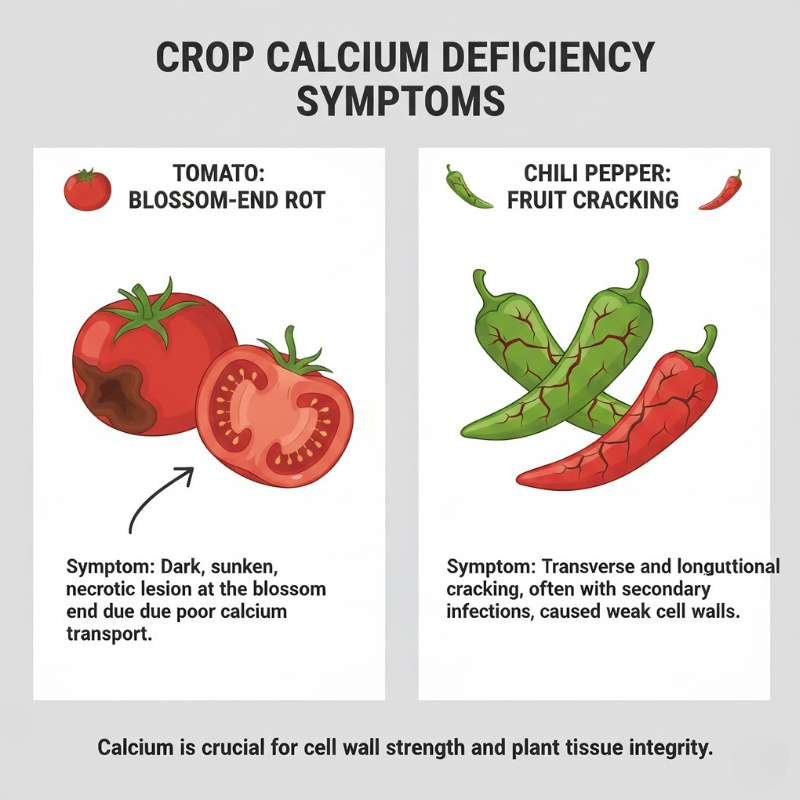
Calcium is a vital component of plant cell walls. Calcium deficiency leads to:
- Soft, easily cracked fruits
- Blossom end rot
- Short shelf life
- High transport damage rates
- Leaf deformation and tip burn
🔍 Plants cannot translocate calcium internally → Continuous supplementation is essential.
Calcium nitrate is the only fertilizer capable of stably supplying water-soluble calcium.
III. Core Advantages of Calcium Nitrate (Compared to Other Calcium Fertilizers)
| Calcium Source | Water Solubility | Absorption Speed | Chloride Content | Drip Irrigation Compatibility | Cost | Suitable Crops |
|---|---|---|---|---|---|---|
| Calcium Nitrate (CN) | ⭐⭐⭐⭐⭐ | ⭐⭐⭐⭐⭐ | Chloride-free | Perfectly compatible | Moderate | All fruits and vegetables |
| Calcium Chloride | ⭐⭐⭐⭐ | ⭐⭐⭐⭐ | Contains chloride (unsuitable for blueberries) | Moderate | Low | Not suitable for sensitive crops |
| Lime Calcium | ⭐ | ⭐ | Chloride-free | Not suitable for drip irrigation | Low | Soil amendment |
| EDTA Chelated Calcium | ⭐⭐⭐⭐ | ⭐⭐⭐⭐⭐ | Chloride-free | Compatible | High | Premium agriculture |
Calcium nitrate ranks highest across all three dimensions—chloride-free, high solubility, and rapid absorption—making it the ultimate choice for high-value crops.
IV. Typical Calcium Deficiency Symptoms (Most Common Issues Observed on Farms)
The most significant role of calcium nitrate in fruit and vegetable production is reducing physiological disorders caused by calcium deficiency:
1. Tomato Blossom End Rot
Blackening at the fruit base → rotting → complete loss of market value.
2. Thin Grape Skins and Fruit Cracking
Leads to higher post-harvest losses during storage and transport—especially critical for export-oriented vineyards.
3. Pepper Fruit Cracking and Malformation
4. Soft Strawberries with Short Shelf Life
5. Reduced Bloom and Lower Firmness in Blueberries (Blueberries Are Highly Chloride-Sensitive)
🔍 Conclusion: Any fruit or vegetable crop aiming for premium quality must use calcium nitrate for calcium supplementation.
V. Hansol Chemical’s Calcium Nitrate Product Specifications (Export Grade)
Hansol Chemical’s calcium nitrate is manufactured from high-purity raw materials, meeting the following export standards:
| Parameter | Specification |
|---|---|
| Appearance | White crystals or granules |
| CaO | ≥ 26% (high purity) |
| Nitrogen (N) | 14–15% (as nitrate nitrogen) |
| Chloride Ion | ≤ 0.02% (chloride-free, agricultural grade) |
| Water Solubility | 100% |
| Particle Size | 1–4 mm (customizable) |
| Packaging Options | 25 kg, 50 kg, 1000 kg, OEM |
| Certifications | SGS, COA, MSDS, marine export compliance |
Fully compatible with global drip irrigation systems, greenhouses, high tunnels, and premium orchard supply chains.
VI. Application Methods and Dosage for Calcium Nitrate (Drip Irrigation Is Optimal)
1. Drip Fertigation (Optimal Absorption Method)
- Dosage: 5–10 kg per acre per application
- Frequency: Every 7–10 days
- Suitable Crops: Tomatoes, peppers, grapes, blueberries, bananas
2. Soil Drenching
Recommended for regions with severe soil calcium deficiency.
- Dosage: 10–15 kg per acre
3. Foliar Spraying (Rapid Calcium Correction)
Only for emergency correction of acute calcium deficiency.
- Dilution: 0.3–0.5% spray solution
Drip irrigation provides the most consistent calcium delivery and represents the global mainstream trend.
VII. Global Demand Trends for Calcium Nitrate (2025–2028 Forecast)
1. Expanding Cultivation Areas of High-Value Crops (e.g., Blueberries, Grapes, Tomatoes)
→ Directly driving increased demand for calcium nitrate (CN).
2. Surging Demand for Chloride-Free Calcium Fertilizers
Fueled by the growth of chloride-sensitive crops like blueberries, grapes, and strawberries.
3. Widespread Adoption of Drip Irrigation Systems in Southeast Asia, the Middle East, and Africa
→ Driving annual growth of 8–12% in water-soluble fertilizer usage.
4. Modern Agriculture’s Increasing Focus on Quality and Post-Harvest Performance
Further elevating the role of calcium nitrate in export-grade orchards.
VIII. Crop Suitability List for Calcium Nitrate (Top 10 Most Commonly Treated Crops Worldwide)
- Tomatoes
- Peppers
- Grapes
- Blueberries
- Strawberries
- Citrus fruits
- Bananas
- Apples
- Cucumbers, eggplants
- Various leafy vegetables
Any crop prioritizing firmness, appearance, storability, transportability, and overall quality benefits from calcium nitrate application.
IX. Frequently Asked Questions (FAQ)
Q1: Can calcium nitrate be mixed with phosphorus fertilizers?
It is compatible with most fertilizers but should not be heavily mixed with phosphate-containing solutions that may form insoluble calcium-phosphate precipitates in hard water.
Q2: Is calcium nitrate acidic or alkaline?
It is neutral to slightly alkaline, soil-friendly, and does not cause acidification.
Q3: Can blueberries use calcium nitrate?
Yes—and it is the optimal calcium fertilizer specifically recommended for blueberries, as they cannot tolerate calcium chloride.
Q4: What is the difference between calcium nitrate and calcium chloride?
Calcium nitrate is chloride-free and ideal for fruits and vegetables; calcium chloride is lower-cost but may cause phytotoxicity or leaf burn.