Global Quality Standards for Water-Soluble Fertilizers: Solubility, Heavy Metal Limits, Impurity Control, and Export Inspection (SGS/COA) Explained (2025)
I. Why Do Water-Soluble Fertilizers Require Strict International Quality Standards?
Water-Soluble Fertilizers (WSF) are widely used in:
- Drip irrigation / fertigation
- Foliar feeding
- High-value crops (fruit trees, vegetables, berries, horticulture)
- Greenhouse agriculture and precision farming
Because they are applied via direct dissolution, WSFs demand significantly higher purity, solubility, and lower heavy metal content than conventional compound fertilizers. Consequently, international markets continue to raise their quality standards for water-soluble fertilizers.
II. Water Solubility — The Core Quality Indicator
The Water Solubility Test is a fundamental requirement for exporting water-soluble fertilizers:
✔ Complete Solubility (100% Dissolution)
After dissolution, the solution must contain none of the following:
- Suspended solids
- Insoluble residues
- Sand or silt
- Crystalline impurities
- Metallic rust particles
✔ Regional Water Solubility Requirements:
| Market | Solubility Requirement |
|---|---|
| Southeast Asia | Must be fully soluble to prevent clogging drip irrigation systems |
| Middle East (UAE/KSA) | Stricter: zero particles, zero impurities |
| European Union | Must comply with EC Fertilizer regulations |
| Latin America | Requires Certificate of Analysis (COA) with batch-by-batch solubility testing |
The most immediate risks of inadequate solubility: clogged irrigation lines, phytotoxicity, and rejection by importers.
III. Heavy Metal Limits — A Globally Monitored Standard
International markets are increasingly concerned about fertilizer safety, particularly whether heavy metal levels exceed permissible thresholds.
Below are globally accepted limit ranges (with minor variations by country):
| Heavy Metal | Typical Limit (ppm) | Notes |
|---|---|---|
| Cadmium (Cd) | 1–5 ppm | Critical for NPK and phosphate-based fertilizers |
| Lead (Pb) | <10 ppm | Strictly regulated for food crops |
| Arsenic (As) | <2 ppm | Stringent in Middle East/EU |
| Chromium (Cr) | <10 ppm | Monitored by many countries |
Since water-soluble fertilizers are commonly applied to high-value crops, in Middle Eastern and EU markets:
Lower heavy metal content → Higher market acceptance → Premium pricing.
Hansol Chemical’s nitrate raw materials (Calcium Nitrate/CN and Magnesium Nitrate/MN) naturally contain very low levels of heavy metals, offering a clear competitive advantage.
IV. Impurity and Chloride Content Control — Determining Product Grade
Chloride (Cl⁻) is one of the most critical parameters affecting water-soluble fertilizer quality.
Many crops—such as tomatoes, grapes, strawberries, and leafy greens—are highly sensitive to chloride. Therefore, global markets generally require:
✔ Chloride-free or Low-chloride (<0.02%)
Especially in the UAE, KSA, Qatar, and similar regions:
- Calcium Nitrate (CN) and Magnesium Nitrate (MN) are highly advantageous as chloride-free nutrient sources
- Premium NPK formulations often highlight “Chloride-free” as a key selling point
V. Purity and Primary Nutrient Standards
Export-grade water-soluble fertilizers must meet minimum nutrient content requirements set by importing countries for primary nutrients (N, P₂O₅, K₂O, CaO, MgO).
Examples (Common Formulations):
| Formulation | Primary Nutrient Requirements |
|---|---|
| 20-20-20 | Each nutrient within ±1% or ±2% tolerance |
| 13-40-13 | P₂O₅ ≥ 40% |
| CN (Calcium Magnesium Nitrate) | CaO ≥ 26%, N ≥ 15% |
| MN (Magnesium Nitrate) | MgO ≥ 15%, N ≥ 11% |
Any deviation beyond permitted nutrient tolerances may result in product rejection or accusations of false labeling.
VI. Particle Size and Physical Appearance
Water-soluble fertilizers should exhibit:
- Uniform crystal structure
- Consistent powder fineness
- No hard lumps
- No caking due to moisture absorption
- No discoloration or foreign particles
For highly hygroscopic products like calcium nitrate and magnesium nitrate, packaging technology is especially critical:
- Inner moisture-barrier film
- Multi-layer composite bags
- Aluminum-lined packaging to enhance storage stability (particularly in tropical countries)
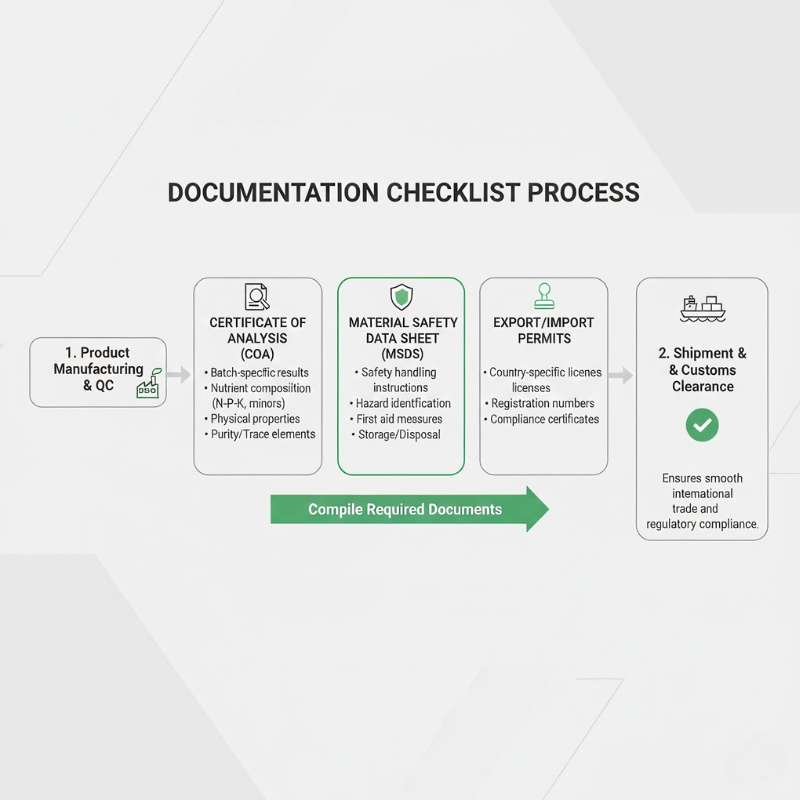
VII. Certificate of Analysis (COA) Requirements — The Essential Export Document
The Certificate of Analysis (COA) is among the most scrutinized documents by buyers.
A compliant COA must include:
✔ Primary nutrients (N, P₂O₅, K₂O, CaO, MgO)
✔ Water solubility (%)
✔ Heavy metals (Cd, Pb, As, Cr)
✔ Impurities
✔ pH and particle size
✔ Production date / batch number
✔ Testing laboratory (in-house or third-party)
✔ Testing methodology (e.g., AOAC / ISO)
If discrepancies appear in the COA, importing countries may:
- Require retesting
- Impose fines
- Even reject or destroy the shipment
VIII. SGS / CIQ Inspection — Third-Party Testing Commonly Required by International Buyers
Agencies such as SGS, CIQ, and BV provide:
- Nutrient composition analysis
- Heavy metal testing
- Water solubility verification
- Physical quality inspection
- Pre-shipment inspection (PSI)
- Loading supervision
Buyers in the Middle East and Southeast Asia commonly stipulate:
“SGS before shipment” as a contractual requirement.
IX. Quality Requirement Differences Across Major Global Markets
Southeast Asia
- Emphasis on solubility
- Moderate heavy metal limits
- Preference for chloride-free fertilizers
Middle East
- Strong preference for chloride-free products
- Strict heavy metal limits
- High demand for high-purity fertilizers
European Union
- Most stringent heavy metal controls
- Greater focus on sustainability and environmental standards
Latin America
- Emphasis on accuracy of declared nutrient content
- High requirements for label authenticity
X. Hansol Chemical’s Water-Soluble Fertilizer Quality and Testing System
Hansol Chemical’s products meet the highest global standards:
✔ High purity, minimal impurities
✔ Extremely low heavy metal content
✔ 100% water solubility
✔ Multi-layer moisture-resistant packaging
✔ Batch-specific COA
✔ Optional SGS certification
✔ Compliance with stringent Southeast Asian and Middle Eastern requirements
This positions Hansol products with a distinct competitive edge in the global premium water-soluble fertilizer market.